Full-round goose feathers are cut from primary wing positions (#1–#4) with naturally symmetrical thick quills (1.55–1.68 mm), delivering 2.5–3.5 sets of tournament-grade flight stability. Straightened goose feathers use curved secondary/humpback goose quills thermally steam-pressed flat, delivering genuine goose durability (1.5–2.2 sets) at 25%–35% lower FOB cost—making them the top value choice for league clubs and coaching academies.
- Anatomical Origin: Full-round uses primary goose flight feathers; straightened goose uses naturally arched secondary quills pressed under controlled steam.
- FOB Cost Advantage: Straightened goose grades save 25%–35% per dozen versus Grade-1 full-round goose while outlasting mid-tier duck feathers.
- Humidity & Shape Memory: Low-grade straightened quills rebound in >75% RH tropical courts unless processed with dual-stage steam conditioning.
- Optimal Cork Pairing: Pair full-round goose with 100% Full Natural Solid Wood Cork; pair straightened goose with 3-Layer Sandwich Cork for peak club ROI.
1. Wing Anatomy & Mechanical Differences: Full-Round vs. Straightened Goose
Many international buyers notice two goose-feather shuttlecocks priced $4 to $6 apart per dozen even though both are labeled "100% Goose Feather." The price gap comes down to feather wing position and mechanical straightening. Only 4 to 6 primary feathers per goose wing possess a naturally broad, symmetrical vane with a straight 1.60 mm+ keratin shaft suitable for Full-Round (Da Fang / Quan Yuan) tournament shuttles.
Lab-Measured Engineering Benchmark Comparison
Secondary curved goose feathers (often called humpback or arched goose quills) have the same dense goose keratin structure, but require precision thermal steam pressing and laser camber sorting (SL-04) so all 16 feathers form a clean 65–68 mm aerodynamic skirt cone.
| Engineering Parameter | Full-Round Goose (Tournament) | Straightened Goose (Club League) | Buyer Impact |
|---|---|---|---|
| Wing Feather Position | Primary #1–#4 (naturally straight) | Secondary arched / humpback | Raw feather yield & supply scarcity |
| Quill Wall Thickness | 1.55 – 1.68 mm thick shaft | 1.38 – 1.52 mm dense shaft | Resistance to framing & shaft snap |
| Thermal Straightening | None required (natural arch) | Controlled steam press + cool set | Requires SL-04 camber match for zero wobble |
| Flight Stability (400+ RPM) | Grade A+ (wobble <0.5%) | Grade A (wobble <1.0%) | Crisp late deceleration at baseline |
| Average Match Durability | 2.5 – 3.5 intense sets | 1.5 – 2.2 club sets | Cost-per-hour optimization |
| Typical Factory FOB Diff | Baseline (100% Tournament Tier) | 25% – 35% Lower FOB Cost | Best ROI for weekly club nights |
2. The Humidity Test: Preventing Straightened Feathers From Curving Back
The biggest quality risk with cheap straightened goose shuttlecocks is keratin shape memory. If a small workshop irons curved feathers dry at excessive heat, the keratin weakens and turns brittle in winter—or slowly springs back toward its natural arch inside humid 75%+ RH Southeast Asian halls, causing inconsistent late-game wobble.
4 Factory Controls That Guarantee Straightened Goose Stability
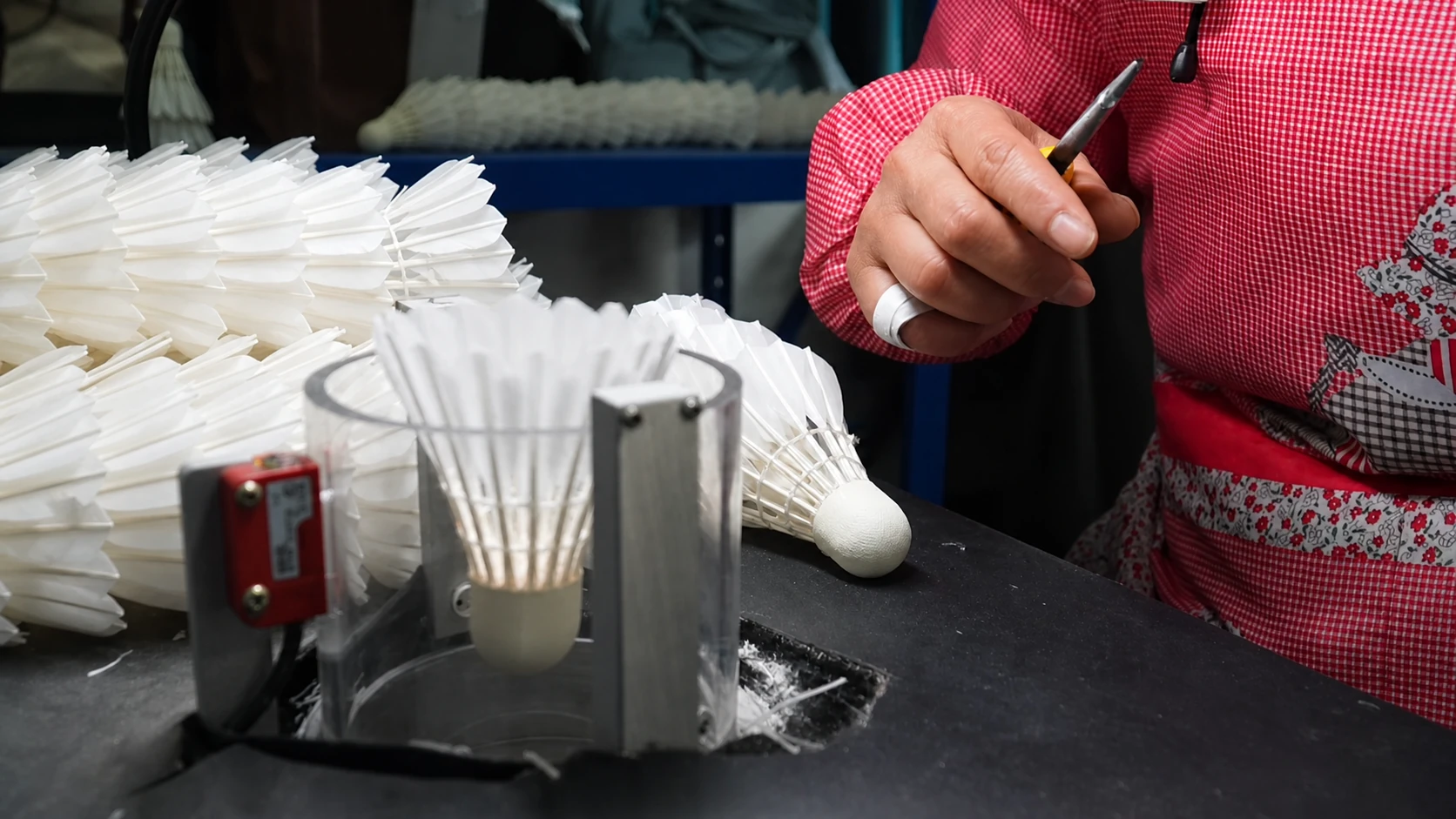
At our Jiangshan facility, every straightened goose lot passes four strict conditioning checkpoints before insertion:
- Steam-Humidified Keratin Softening: Quills are softened with saturated low-pressure mist before pressing so keratin fibers realign without scorching.
- 24-Hour Resting & Moisture Lock: Pressed feathers rest in a 12%–14% moisture-controlled chamber to expose any spring-back quills before sorting.
- SL-04 Laser Camber Grouping: Optical laser sorters bin feathers within ±0.2 mm arch tolerance so all 16 feathers inside one shuttle share identical curvature.
- 50-Smash Humidity Fatigue Audit: Batch samples undergo smash cannon testing (SL-21) to confirm skirt symmetry holds through full club matches.
3. Matching Goose Feather Cut & Official Cork Base to Your Buyers
Smart wholesalers rarely sell only one goose grade. Instead, they position Full-Round Goose on 100% Full Natural Solid Wood Cork as their flagship tournament model, while positioning Straightened Goose on 3-Layer Sandwich Cork as their high-volume club league bestseller.
B2B Procurement Matrix & Factory Reference Models
Use this tier chart to select the exact combination of feather cut, cork base, and speed calibration for your club or distributor catalog:
| Buyer Segment | Recommended Feather Cut | Official Cork Base Pairing | Factory Ref Tier | Recommended Positioning |
|---|---|---|---|---|
| Pro Tournaments & Federations | Grade-1 Full-Round Goose | 100% Full Natural Solid Wood Cork | AP-G1 Flagship Series | Official match ball ($26–$34 retail) |
| Competitive Club Leagues | Grade-1/2 Straightened Goose | 3-Layer Sandwich Cork | AP-G2 / AP-311 Tier | Primary club workhorse ($18–$24 retail) |
| High-Volume Coaching & Drills | Straightened Goose / Teal Duck | 2-Layer Composite Cork | SJ-106 / Club Training | Multi-shuttle basket ROI ($13–$17 retail) |
4. How to Inspect Full-Round vs. Straightened Goose in 30 Seconds
Hold a shuttlecock horizontally toward bright light and inspect the mid-quill curve where the shaft meets the upper coil thread. Full-round primary feathers display uniform symmetrical vanes on both sides of the central rib and zero micro-crease lines along the spine, whereas straightened goose feathers show slightly narrower inner vanes with uniform, cleanly matched curvature across all 16 blades.
Test Both Cuts Side-by-Side Before Committing to Bulk Orders
Request our mixed 1-tube evaluation pack pairing Grade-1 Full-Round Goose (AP-G1) alongside Straightened Goose and Class-A Teal Water Duck so your club players can verify flight feel and cost-per-game directly on court.
Compare Live Factory SKUs & Related Feather Guides
Inspect actual goose & duck models and request a side-by-side blind test kit:
- AP-G1 Grade-1 Full-Round Goose Flagship — 100% Full Natural Solid Wood Cork tournament benchmark.
- 104-SKU Factory Shuttlecock Catalog — Filter live across full-round goose, straightened goose, duck, and nylon tiers.
- Order a Mixed 1-Tube Comparison Sample — Test full-round vs. straightened goose directly on your club courts.
- Goose vs. Duck Feather Procurement Guide — Compare quill wall density, flight curve, and wholesale pricing.
- 5 Shuttlecock Feather Cuts Decoded — Full-round, big-square, medium-square, humpback, and single-side breakdown.
Technical & Sourcing FAQs
What is the main difference between full-round goose and straightened goose feathers?
Do straightened goose feather shuttlecocks wobble in humid weather?
Which goose feather cut offers better value for weekly club play?
What cork base should pair with full-round goose tournament shuttlecocks?
Can I compare full-round and straightened goose samples in one trial shipment?
Compare Full-Round & Straightened Goose On Your Court
Request a side-by-side factory evaluation kit with Speed 76/77/78 calibration and tiered wholesale pricing for your club or brand.